Cities
A defined place for micromobility in public space.
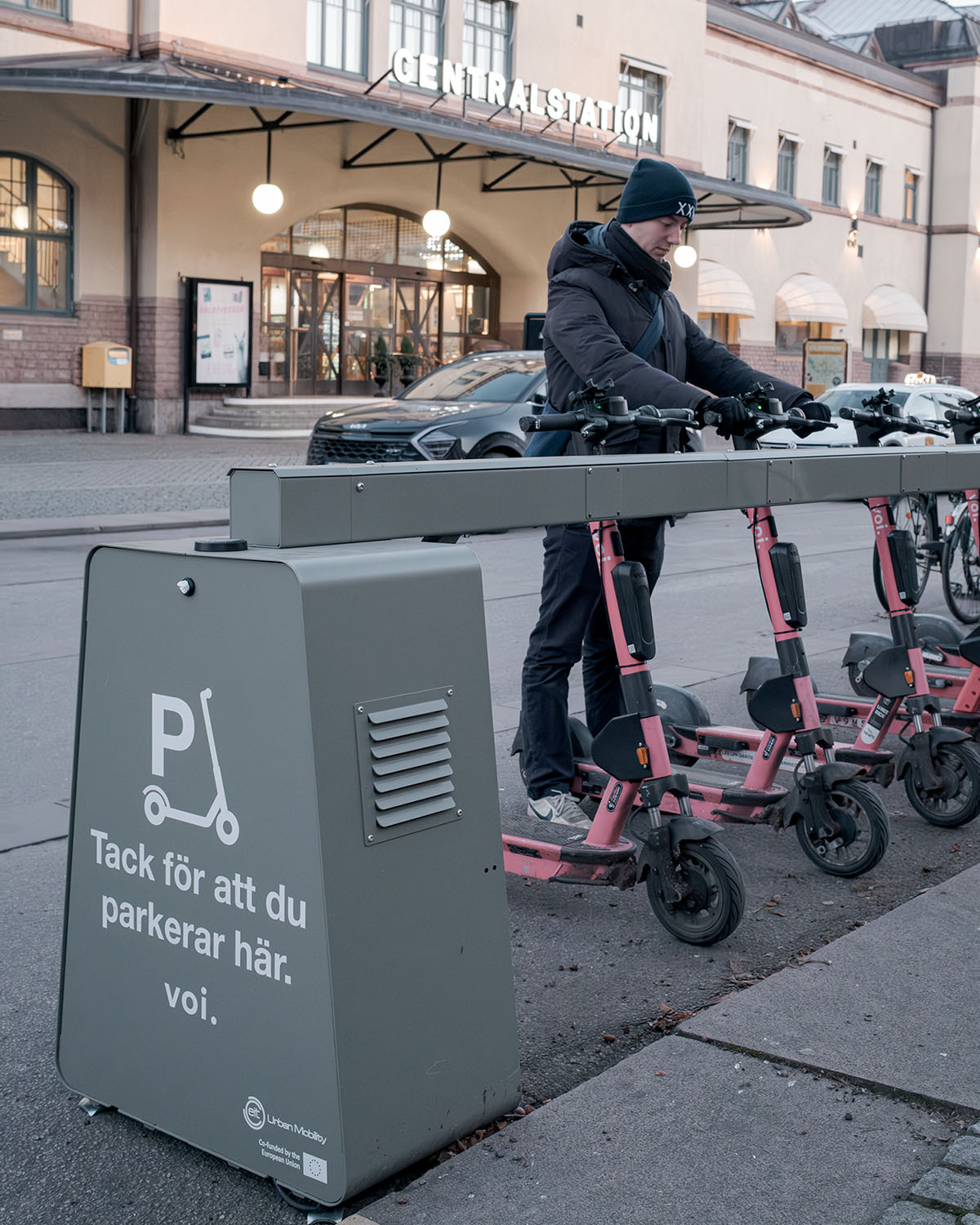
Parking and charging infrastructure that reduces clutter, protects accessibility, and gives shared mobility a defined place in public space.
The problem
When useful mobility creates public-space pressure.
Shared vehicles help people move through the city, but without physical infrastructure they often compete with the same public space they are meant to support.
The issue is not micromobility. It is the lack of a fixed place for vehicles to park, charge and be managed.
Street clutter
Vehicles left without a clear return point create visual disorder, blocked routes, and repeated complaints. Cities are forced into case-by-case response.
Accessibility risk
Blocked footpaths, ramps, and entrances affect people with reduced mobility first. Enforcement after the fact does not protect access by default.
Weak governance
Rules and geofencing can guide behavior, but they do not create a physical place for vehicles to return, charge, and be managed.
The shift
From managed exceptions to planned infrastructure.
Standab introduces fixed parking and charging nodes into the urban fabric. Vehicles arrive, park, and charge at city-approved points in public space.
This moves micromobility from a complaint-driven category to a planned transport layer, with clear locations, shared rules, and measurable use.
When vehicles have a known place, cities can integrate shared mobility into streets, transit locations, and public-space planning with confidence.
For cities
What cities get.
Each outcome reduces a specific public-space or governance problem cities currently manage manually.
01
Public space and accessibility
Defined nodes keep footpaths, squares, and entrances clear. Accessibility is protected by design, not handled only after complaints.
02
Sustainable urban mobility
Charging infrastructure supports electric shared fleets without requiring the city to operate vehicles or manage battery logistics.
03
Governance and oversight
Cities determine which locations are active and under what conditions. Operators work inside a city-defined framework.
04
Long-term planning logic
Nodes can be piloted, evaluated, relocated, and expanded as the city changes. Micromobility becomes part of planning, not an exception to it.
Financing
Infrastructure financed through charging services.
Standab finances and installs the infrastructure through charging services. Cities contribute approved locations and retain control of public-space decisions.
Financed through services
Infrastructure costs are covered by charging services used by operators, rather than upfront infrastructure investment.
Shared infrastructure
Multiple operators can use the same nodes. Cities get one infrastructure layer rather than separate physical arrangements per operator.
Public space stays public
Location decisions, usage rules, and access conditions are set by the city. Third parties operate within that framework. Governance does not transfer.
Structured rollout
Start with a defined pilot zone. Expand based on evidence. No large upfront commitment, no stranded asset, no lock-in.
Implementation
Phased rollout. Validated before expansion.
Each phase is evaluated before the next begins. Expansion follows usage, public-space impact, and operator performance.
01
Site analysis
Flow patterns, operator data, accessibility needs, and candidate locations mapped with city planners. Permits, operator access, and end-of-contract conditions are settled jointly at this stage.
02
Pilot deployment
Nodes installed in a defined zone. Active within weeks. Operators integrated from day one.
03
Evaluation
Usage data reviewed with city stakeholders. Compliance, accessibility, rebalancing, and public-space impact assessed jointly.
04
Optimisation
Node positions adjusted. Capacity calibrated to actual demand. Underperforming locations relocated.
05
Scaling
Expansion agreed based on pilot results. The model is already proven before additional zones are committed.
Impact
Visible impact in public space.
The change is measurable at the node level and visible in the street.
Without infrastructure
Vehicles parked anywhere
No defined location, no predictability
Blocked footpaths
Pedestrian routes and access points obstructed
Complaint-driven response
Issues handled after the fact, repeatedly
No city visibility
Vehicle location and space usage unknown
With Standab nodes
Fixed, city-approved locations
Vehicles arrive and charge at defined points
Clear public space
Footpaths and access routes maintained by default
Structured operations
Predictable rebalancing, fewer complaints
City-level oversight
Usage data available, governance retained
Shared mobility and public-space order are not in conflict.
- A defined place for shared vehicles in public space
- Accessibility protected by node placement, not after the fact
- Infrastructure financed through charging services used by operators
- Pilot first, scale based on measured public-space impact